Field note — A working apiary and honey house
A working apiary, kept the way the bees themselves would explain it.
Forty-some colonies across five sites, a honey house that grades every jar on the same scale a USDA inspector would use, and two tools on this site that run the real numbers rather than approximate them for you.
under management this season
The colonies
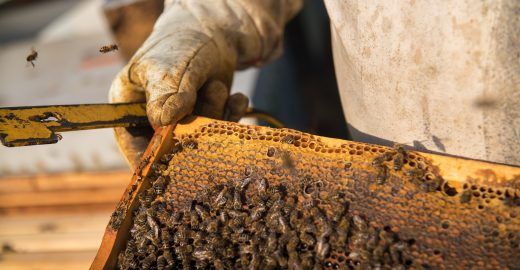
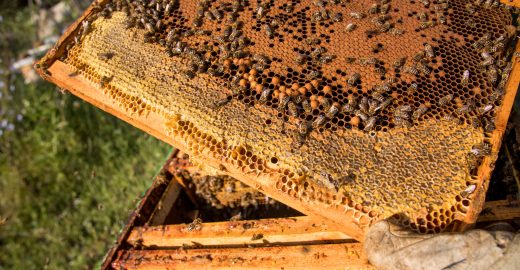
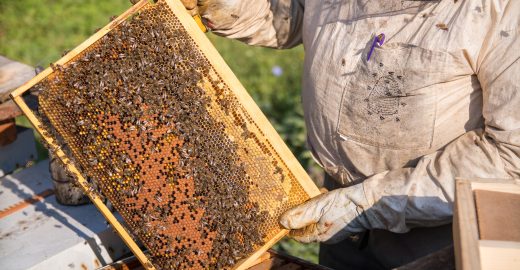
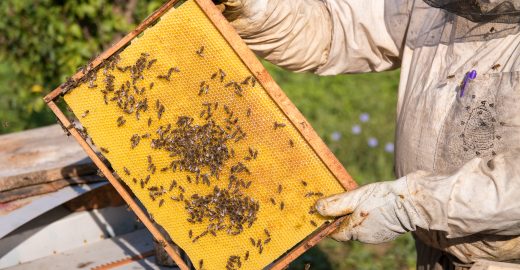
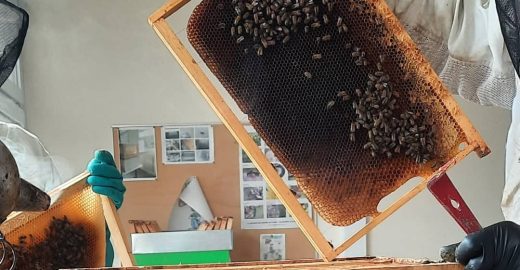
Every hive, by the box it is actually stacked in.
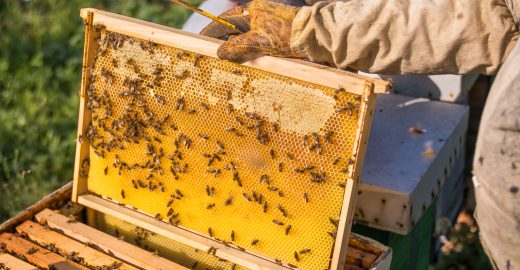
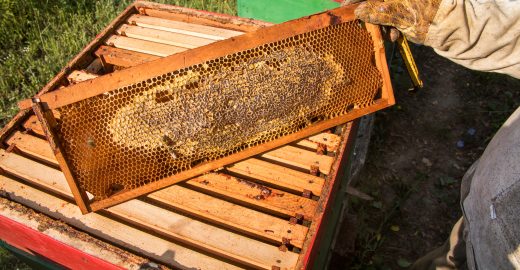
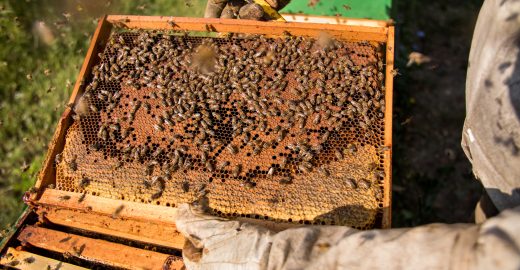
These are not cards. They are laid out the way real supers hold real frames — grouped by box, sized to a deep frame's own proportions.
The workbench
The two calculations behind the honey house.
A forager cannot see the sun from inside a dark hive, so she dances its bearing instead — and every jar that leaves here is graded on the same scale a USDA inspector uses, not by eye.
This season's honey
Graded, not guessed.
Every colour swatch below comes from the harvest's own Pfund reading, run through the real USDA breakpoints — not chosen to look nice.
| Variety | Harvest | Moisture | Grade | Jars |
|---|---|---|---|---|
| Spring clover Clover | Late May 2026 | 17.4% | Water White | 340g, 1kg |
| Basswood Basswood | Late June 2026 | 17.8% | Water White | 340g, 500g |
| Wildflower blend Wildflower | July 2026 | 18.1% | Extra White | 340g, 1kg, 3kg |
| Buckwheat Buckwheat | September 2026 | 18.4% | Light Amber | 340g |
| Goldenrod Goldenrod | October 2026 | 18.0% | Amber | 340g, 1kg |
| Creamed clover Clover | Late May 2026 (whipped) | 17.2% | Extra White | 250g |
| Comb honey, wildflower Wildflower | July 2026 | 17.9% | White | 1 section |
The hive year
What actually happens, month by month.
Spring buildup
First inspections once it clears 13°C; feed if stores are thin; start equalising weak colonies against strong ones.
Swarm season
Weekly checks for queen cells; give brood room ahead of the nectar flow; split anything that is already crowding ten frames.
Main flow
Supers go on faster than seems reasonable; this is most of the year's honey in about six weeks.
Harvest
Pull, extract, and grade — every batch gets a Pfund reading before it is labelled.
The dearth
Forage dries up; watch for robbing; this is when a weak colony is most exposed.
Fall prep
Mite counts and treatment, then feed syrup until they stop taking it — that is the real signal, not the calendar.
Overwintering
Cluster left alone; the only real intervention is a hefting check for stores after a thaw.
Find us
Markets and stockists
Downtown farmers market, Courthouse Square
Downtown farmers market, Courthouse Square · 8am–1pmMidweek market, Fennimore Park
Midweek market, Fennimore Park · 3pm–6pmMeadowline honey house (retail pickup)
Meadowline honey house (retail pickup) · 10am–2pm“They deliver strong colonies exactly on bloom, not on a date that happened to be convenient. Our set fruit has been noticeably better since we switched.”
“The Pfund reading on the label actually means something — I stopped getting complaints about inconsistent color between batches the day we switched suppliers.”
“I came in not knowing which end of the smoker to light. Six months later I split my own first colony without calling for help.”
Beyond honey
What else we do
Wholesale honey
Bulk clover, wildflower, and late-season varieties by the pail or drum, graded and lab-tested on request.
- Pfund grading sheet with every lot
- Moisture-tested to Grade A (≤18.6%)
- 5-gallon pails or food-grade drums
Pollination contracts
Colonies delivered and set for orchard or vegetable-seed pollination on a per-hive contract.
- Minimum 6-frame colony strength guaranteed
- Delivery and pickup included within 40km
- Placement timed to bloom, not the calendar
Swarm removal
Live removal of established colonies from structures, and collection of clustered swarms.
- Cavity cut-outs with comb transfer where possible
- No pesticide use — bees are relocated live
- Response typically within 24 hours in season
Nucleus colonies & queens
Locally overwintered nucs and mated queens off our own breeder lines.
- 5-frame nucleus, laying queen, brood in all stages
- Carniolan, Italian, and Russian-hybrid lines available
- Pickup at Meadowline or limited local delivery
Education & tours
Yard visits and beginner beekeeping instruction, on-site or at the honey house.
- Full-suit hive inspections, small groups
- Extraction-day demonstrations at harvest
- Mentoring for first-year beekeepers
Get in touch
Wholesale, pollination, or a swarm on your porch.
We read every message ourselves. Tell us what you need and we will follow up, usually within a couple of days.